 PURIX
What does XRF mean?
XRF stands for X-ray fluorescence. It is a non-destructive analysis technique widely used for elemental analysis of many materials, such as metals, glass, ceramics and rocks.12 The question in the jewellery trade is simple: which metals are in this piece, and how much of each? XRF answers it by measuring how the atoms in the piece respond to X-rays.
The fluorescence in the method's name means that a substance gives back the energy it has received as a ray characteristic of itself. In XRF this ray is also an X-ray; what captures and counts it is the detector inside the device.2
What happens inside the atom?
When the X-rays from the device's tube strike the piece, they knock some electrons out of the inner shells of the atoms (the K and L levels). An electron from an outer shell fills the vacancy. The energy released in this transition is emitted as a new X-ray.12
The energy of this ray is characteristic of the type of atom that emits it. That is why the energy of a ray tells you which element it comes from.12 For example, gold emits at 9.71 keV and silver at 22.16 keV.3
How are karat and fineness calculated?
XRF devices come in two types, depending on how they separate the rays. In energy-dispersive devices the detector both captures each incoming ray and measures its energy; separating and counting happen in a single step.2 The electric charge produced in the detector is proportional to the energy of the incoming ray, so each ray is recorded in the right energy bin.2
In the other type, wavelength-dispersive devices, the rays are separated by diffraction on a crystal before they reach the detector.2 Both types rest on the same principle: each element emits rays at its own characteristic energy, and the amount of these rays shows that element's share.
The intensity of the rays from an element is proportional to the amount of that element in the piece. The exact value of this proportion is found by comparison with reference samples of known composition; this is called calibration.12 The software uses the calibration to convert each element's count into a percentage. Once the gold percentage is known, karat and fineness are calculated directly: if 750 parts out of 1,000 are gold, the result is a fineness of 750, i.e. 18 karat.
| Stage | What happens | What it means in the result |
|---|---|---|
| Excitation | X-rays knock out the atoms' inner electrons | The measurement begins |
| Fluorescence | Each element emits rays at its own characteristic energy | Which elements are present |
| Counting | The detector counts the rays by energy | The signal amount for each element |
| Calibration | The counts are compared with known samples | Element percentages, karat and fineness |
Limits of XRF: what a jeweller should know
- It measures the surface. Fluorescence rays come largely from the upper layers of the piece; for light elements this is just a few micrometres.2 XRF measures the surface: with thin plating, the base metal underneath (e.g. copper, zinc) shows up in the result and the plating is revealed. If you suspect thick plating or a filled piece, measure it at several points; a destructive test may be nee
- Calibration depends on the material. A calibration is valid just for a particular range of materials; the composition and structure of the piece affect the count.2
- Very light elements are hard to measure. Elements lighter than sodium are often difficult to measure quantitatively.2 The metals of interest in gold alloys (such as gold, silver, copper and zinc) are much heavier than that.
A measurement on PURIX X1
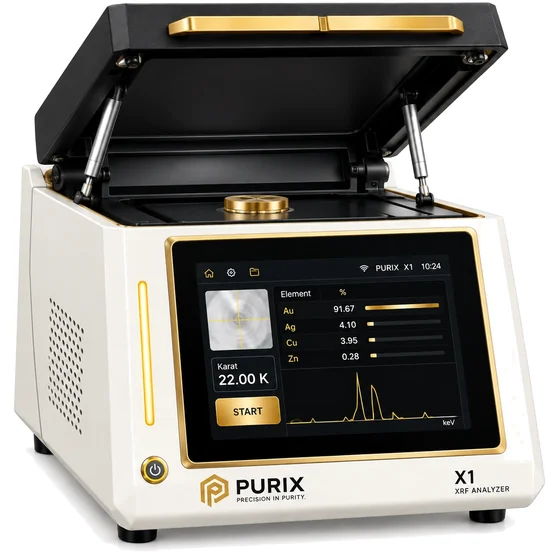
PURIX X1 is a benchtop XRF gold analyzer with a Si-PIN detector. It measures up to 20 elements in gold without damaging the piece: no cutting, no touchstone, no acid.3
FAQ
Does XRF damage gold?
No. XRF is a non-destructive method; the measurement involves no cutting, scraping or acid.
Can XRF see inside gold?
No. XRF measures the surface. If you suspect thick plating or a filled piece, measure it at several points; a destructive test may be needed.
How does XRF determine karat?
It measures the percentage of each element; fineness and karat are then calculated from the gold percentage. For example, a fineness of 750 corresponds to 18 karat.
Why is calibration important?
The amount of rays counted by the detector cannot be converted into a percentage without comparing it with samples of known composition. This comparison is called calibration.
All values are measured under the manufacturer’s test conditions and may vary with the shape and surface of the sample.
Karat isn’t guessed. It’s measured.
Try the live analysis to see how a measurement looks on screen, or request a quote for your business.