 PURIX
Gold, karat and measurement.
Useful knowledge for the jeweller’s counter: short, sourced, new every week.
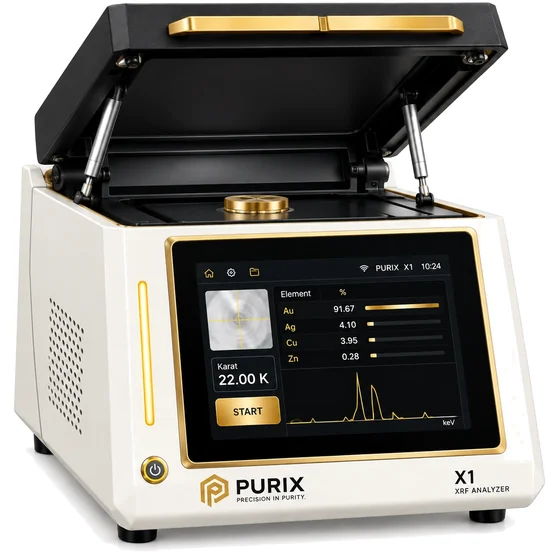
How do you read a gold test result? Karat, fineness and element percentages
At the end of an XRF measurement, the screen shows the karat, the fineness and the element percentages. We explain, with sources, how these three figures follow from each other, what the other metals tell you and what to do when the result does not match the stamp.
October 29, 2026 · 5 min readRead the article AI character
Can you tell gold’s karat by its colour?
No. The colour of gold shows which metals have been mixed into it; it does not show how much gold it contains. Two pieces of the same colour can have different karats, and two pieces of the same karat can have different colours. We explain with examples why colour misleads.
October 27, 2026 · 3 min read AI character
What should the invoice say when you buy gold?
When you buy gold from a jeweller, it is recommended that you ask for an invoice or a receipt. This document should state the type of item, its weight in grams and its karat. We explain how to read the document and how to compare it with the stamp on the item.
October 27, 2026 · 3 min readHow do you convert karat to fineness? Conversion table from 8 to 24 karat
Karat and fineness are two ways of writing the gold ratio: one out of 24, the other out of 1,000. In this article we explain the two-way conversion formula, give the full table from 8 to 24 karat, and show why the number in the stamp can differ slightly from the calculation.
October 26, 2026 · 5 min read AI character
Is gold real if it has a stamp?
A 916, 750 or 585 stamp on jewellery shows the karat; but a stamp on its own does not prove that the gold is real. A stamp can be put on a fake piece too. We explain what the stamp tells you, what it does not, and what else should be checked alongside it.
October 26, 2026 · 3 min read AI character
How many grams is an ounce of gold?
The ounce you see in gold news is a unit of weight called the troy ounce. One troy ounce is 31.1034768 grams; in everyday calculations it is rounded to 31.10 grams. We explain how to convert between ounces and grams, and the two ounces that are often confused.
October 26, 2026 · 3 min read
How do you verify the karat when buying scrap gold?
Scrap gold brings together pieces from different years, different workshops and different karats. The stamp is a starting point, but it is not enough on its own. We explain, with sources, the steps to follow at the jeweller’s bench to verify the karat of a scrap piece.
October 25, 2026 · 5 min read AI character
What is a touchstone? How is gold karat tested on a stone?
A touchstone is a dark, fine-grained stone used to test the karat of gold. The gold is rubbed on the stone, acid is applied to the streak it leaves, and the streak is compared with samples of known karat. We explain, with sources, how the test is done and how the result is read.
October 25, 2026 · 3 min read AI character
Does the magnet test work on gold?
Gold does not stick to a magnet. But a piece not sticking to a magnet does not show that it is gold: metals such as copper, silver and tungsten do not stick to a magnet either. We explain what a magnet can and cannot show.
October 22, 2026 · 3 min read AI character
Why isn't jewellery made from pure gold?
Pure gold, that is 24 karat, is a very soft metal. That is why the gold in jewellery is usually mixed with metals such as copper and silver. We briefly explain what the mix gives gold and how it relates to karat.
October 22, 2026 · 3 min readHow can you tell plated gold?
Plated gold is a piece with a thin layer of gold applied to the surface of another metal. From the outside it is hard to tell apart from solid gold. We explain the types of plating, the marks in the stamp and the steps to follow at the jeweller's counter, with sources.
October 20, 2026 · 5 min read AI character
What does 995 mean on gram gold?
The 995 on gram gold shows that 995 out of every thousand parts of the gold are pure gold. Some gram gold pieces carry 999.9 instead of 995. We explain the difference between the two numbers, where 995 comes from and how it relates to karat.
October 20, 2026 · 3 min read AI character
Is white gold real gold?
White gold is real gold: it is made by adding white metals to pure gold. Its colour comes from these metals and, in most cases, from a rhodium plating on the surface. The amount of gold inside is set by the karat, not by the colour.
October 15, 2026 · 3 min readHow does XRF gold analysis work?
XRF (X-ray fluorescence) is an analysis method that measures the elements in a piece and their proportions without damaging it. In this article we explain, in plain language, the physics of the method, how the result is calculated and the limits a jeweller should know.
October 14, 2026 · 5 min read AI character
What does 916 on a gold bangle mean?
The 916 on a bangle means 22 karat: 916 parts in every thousand of the alloy are pure gold. Here is a short look at where this number comes from, the other numbers on jewellery such as 750 and 585, and what the stamp does not show.
October 13, 2026 · 3 min read AI character
What does 24 karat mean?
Karat tells you how many parts out of 24 are pure gold. 24 karat is pure gold; in 18 karat, three quarters is gold and the rest is other metals. Here is a short guide to reading karat and how it relates to fineness.
October 11, 2026 · 3 min readHow is gold karat measured? Touchstone, acid test and XRF
Karat tells you how many parts out of 24 of an alloy are pure gold. Jewellers commonly measure this ratio in three ways: the touchstone, the acid test and XRF analysis. We compared all three side by side on the same criteria.
October 11, 2026 · 4 min read