 PURIX
Do karat and fineness say the same thing?
Yes. Karat expresses the share of pure gold in an alloy out of 24 parts: 18 karat means that 18 of the 24 parts are gold, that is, 75% of the alloy is gold.1 Fineness writes the same share out of 1,000 parts; it shows how many parts per thousand by weight are pure metal.1 24 karat is pure gold that contains no other metal.2
At the jeweller's counter you will meet both notations: one piece may read 18K, another 750. Both describe the same ratio.
The conversion formula
The formula is simple, but not every karat divides evenly by 24. 14 karat works out to 583.3 fineness; in the stamp, however, 585 is used.12 That is why the table below gives both the calculated value and the number seen in the stamp side by side.
Karat to fineness conversion table
| Karat | Calculated fineness | Seen in the stamp | Gold content |
|---|---|---|---|
| 24 karat | 1,000 | 999 | Pure gold |
| 23 karat | 958.3 | 958 | 95.8% |
| 22 karat | 916.7 | 916 | 91.6% |
| 21 karat | 875 | 875 | 87.5% |
| 20 karat | 833.3 | 833 (834 in some sources) | 83.3% |
| 18 karat | 750 | 750 | 75% |
| 14 karat | 583.3 | 585 | 58.5% |
| 10 karat | 416.7 | 417 | 41.7% |
| 9 karat | 375 | 375 | 37.5% |
| 8 karat | 333.3 | 333 | 33.3% |
The numbers in the stamp column are the common notations given in the sources.12 The 21 karat row was calculated with the formula (21 ÷ 24 × 1,000 = 875).
Why can the number in the stamp differ from the calculation?
A fineness stamp is written as a whole number, while the calculation often comes out with decimals. 22 karat is 916.7 fineness by calculation; the stamp shows 916.1 14 karat is 583.3 fineness by calculation; the decimal form 583.3 is generally not used, and 585 is written instead.1 The sources give both notations for 14 karat: 583 and 585.2
Small differences also appear when converting back: 585 × 24 ÷ 1,000 = 14.04 karat, and 916 × 24 ÷ 1,000 = 21.98 karat. These decimals come from rounding; when reading, take the nearest whole karat.
What is the remaining share: the other metals in the alloy
Fineness only tells you the share of gold; the rest is other metals. For example, in an 18 karat alloy gold is 75%, and the remaining 25% is usually copper or silver.2 The same karat can be reached with different mixtures; yellow, white and rose gold can be of the same karat and contain different metals.2 That is why two pieces can have the same karat but a different colour.
The difference between calculation and measurement
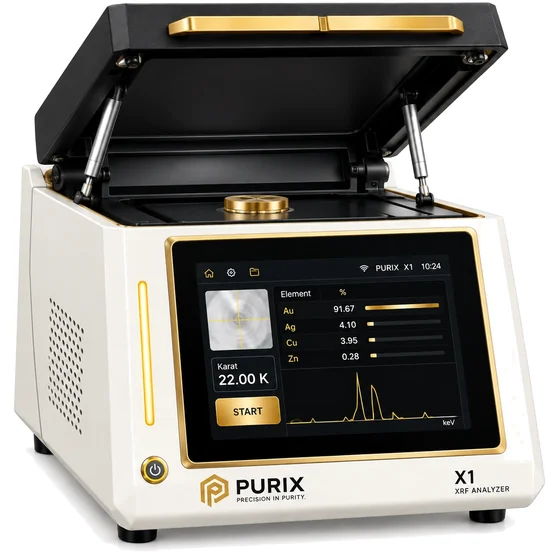
The table tells you how much fineness a karat corresponds to; it does not tell you what fineness the piece in your hand really has. To find the ratio of the piece, it has to be measured. In XRF analysis, the detector counts the rays coming from the piece and the software turns them into ratios; karat, fineness and all 20 elements appear on screen in 30–60 seconds.3
FAQ
What fineness is 14 karat?
By calculation it is 583.3 fineness; in the stamp it is written as 585. The gold content is about 58.5%.
What fineness is 21 karat?
21 ÷ 24 × 1,000 = 875 fineness. 87.5% of the alloy is gold.
Are 999 and 24 karat the same thing?
Yes. The sources give the notation 999 as the equivalent of 24 karat, that is, pure gold.
How do I convert fineness to a percentage?
Just divide the fineness by 10: 916 fineness means 91.6% gold, 750 fineness means 75% gold.
All values are measured under the manufacturer’s test conditions and may vary with the shape and surface of the sample.
Karat isn’t guessed. It’s measured.
Try the live analysis to see how a measurement looks on screen, or request a quote for your business.