 PURIX
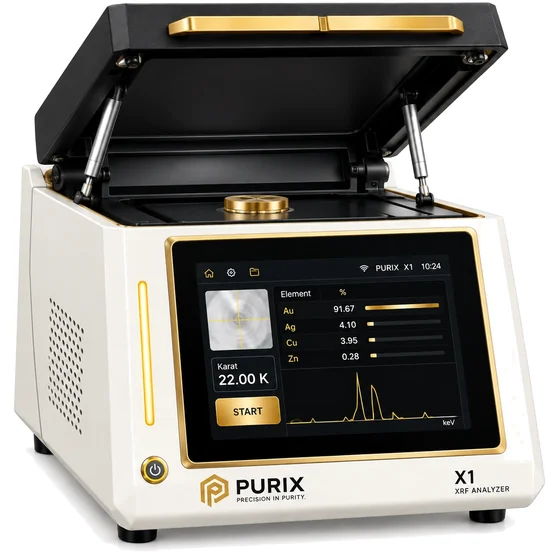
What does the measurement screen show?
In an XRF device, the detector counts the rays coming from the piece and the software turns these counts into ratios. On the PURIX X1, karat, fineness and all 20 elements appear on screen in 30–60 seconds.2 So the result has three parts: the gold percentage, the fineness and karat calculated from that percentage, and the percentages of the other metals in the alloy.
These three figures are linked. Karat expresses the share of pure gold out of 24; fineness expresses it out of 1,000.1 That is why reading a result always starts with the gold percentage.
How do you get fineness and karat from the gold percentage?
The calculation is simple: fineness = gold percentage × 10, karat = gold percentage × 24 ÷ 100. If the screen shows 75% gold, the fineness is 750 and the karat is 18. The table below shows what common stamps correspond to; the karat column is calculated directly from the percentage.
| Gold percentage | Fineness | Calculated karat | Common stamp |
|---|---|---|---|
| 99.9% | 999 | 23.98 | 999 / 24 karat |
| 91.6% | 916 | 21.98 | 916 / 22 karat |
| 75.0% | 750 | 18.00 | 750 / 18 karat |
| 58.5% | 585 | 14.04 | 585 / 14 karat |
| 41.7% | 417 | 10.01 | 417 / 10 karat |
| 37.5% | 375 | 9.00 | 375 / 9 karat |
The reason for the small differences in the table is also known. 14 karat should be exactly 583 fineness (14 ÷ 24), but most manufacturers follow European practice and make 14 karat slightly above that; this is why most 14-karat jewellery is stamped 585. Similarly, 24 karat is 1,000 fineness on paper, but in practice gold can only be refined to a fineness of 999.9.1
What do the other elements tell you?
The share that is not gold consists of the metals that make up the alloy. Adding other metals to pure gold makes it durable and can also change its colour: copper gives a pink tone, while white gold is made by alloying gold with white metals such as palladium or silver.1 White gold alloys containing nickel are in the minority and usually also contain other metals such as copper and zinc.1
| Type | Gold (Au) | Silver (Ag) | Copper (Cu) | Zinc (Zn) |
|---|---|---|---|---|
| Yellow 14 karat | 58.3% | 30% | 11.7% | – |
| Yellow 18 karat | 75% | 15% | 10% | – |
| Yellow 22 karat | 91.7% | 5% | 2% | 1.3% |
| Pink 14 karat | 58.3% | 9.2% | 32.5% | – |
The table shows the World Gold Council's examples of compositions typically used in the jewellery industry; they are not the only way to achieve this colour and karat.1 They are not measurement results.
When reading the result, check whether the percentages of the other metals are consistent with the colour of the piece and the expected alloy. In a yellow piece of jewellery you expect silver and copper; in a pink piece, a clear share of copper.
What if the result does not match the stamp?
A number such as 585 or 750 on a piece is often a karat stamp applied by the manufacturer itself; on its own, it does not indicate an independent measurement.3 If the measurement result differs from the stamp, follow these steps before treating the result as final:
Limits of the result
- The surface is measured. Rays from light elements often come only from the top few micrometres of the piece; a surface that is not representative also affects the result.6
- Calibration matters. The relationship between counts and the amount of an element is found by comparison with reference samples of known composition; this is why XRF relies on materials for which reference samples of similar, well-defined composition are available.7
- One spot tells you about one spot. The result is the composition of the measured spot; a solder joint or a plated surface can give a different result from the body of the piece.24
The result appears on screen; the stamp, a visual check and the measurement are assessed together.
FAQ
The screen shows 58.5% gold. What karat is that?
A fineness of 585, i.e. 14 karat. Calculation: 58.5 × 24 ÷ 100 = 14.04.
Why is 14 karat stamped 585 rather than 583?
14 ÷ 24 gives exactly 583; but because most manufacturers make 14 karat slightly above that, the stamp is usually 585.
Copper and zinc came out high in the result. What does that mean?
They may be part of the alloy; but XRF measures the surface, and with thin plating the base metal underneath (e.g. copper, zinc) shows up in the result. If in doubt, measure the piece at several points; a destructive test may be needed.
If the stamp and the result differ, which one should you trust?
The stamp is the manufacturer's declaration. Check the measuring spot and measure again on a clean area away from solder; if doubt remains, measure at several points.
All values are measured under the manufacturer’s test conditions and may vary with the shape and surface of the sample.
Karat isn’t guessed. It’s measured.
Try the live analysis to see how a measurement looks on screen, or request a quote for your business.
- World Gold Council, “Gold Jewellery: Colour, Carat & Purity”
- PURIX X1 product page: “What happens in one measurement?” and FAQ
- Wikipedia, “Hallmark”
- Wikipedia, “Solder”
- GIA, “Bench Tip: Use the Touchstone Method for Testing Purity of Karat Gold”
- Wikipedia, “X-ray fluorescence”
- SERC, Carleton College, “X-Ray Fluorescence (XRF)”